
Key Takeaways
- The O-1 is faster to enter on, but the EB-1A is the only one of the two that leads to permanent residence and U.S. citizenship.
- The EB-1A needs no employer or sponsor, which allows you to self-petition. In contrast, the O-1 requires a U.S. employer or agent.
- Country of birth matters for the EB-1A, not the O-1. Applicants from India and China can face Green Card backlog waits the O-1 doesn't have.
- Many people qualify for the O-1 earlier in their career and meet the EB-1A bar later.
The O-1 and the EB-1A both recognize foreign nationals with extraordinary ability, but are two separate categories with different benefits and eligibility criteria.
The O-1 is a temporary work visa that you can usually get faster, while the EB-1A is a Green Card that lets you self-petition and leads to permanent residence. Many people qualify for the O-1 first and eventually transition to the EB-1A, and knowing how they differ can tell you which one is a better fit right now.
This article is informed and reviewed by Manifest Law’s practicing immigration attorneys. Our goal is to give you clear, accurate legal guidance you can rely on. Check out our editorial policy for more info.
What's the difference between the O-1 visa and the EB-1A Green Card?
The O-1 is a temporary nonimmigrant visa, while the EB-1A is an employment-based Green Card category. Both recognize extraordinary ability, but the O-1 only lets you work in the U.S. for a fixed period. Once you receive your actual permanent residence card, the EB-1A lets you stay for good.
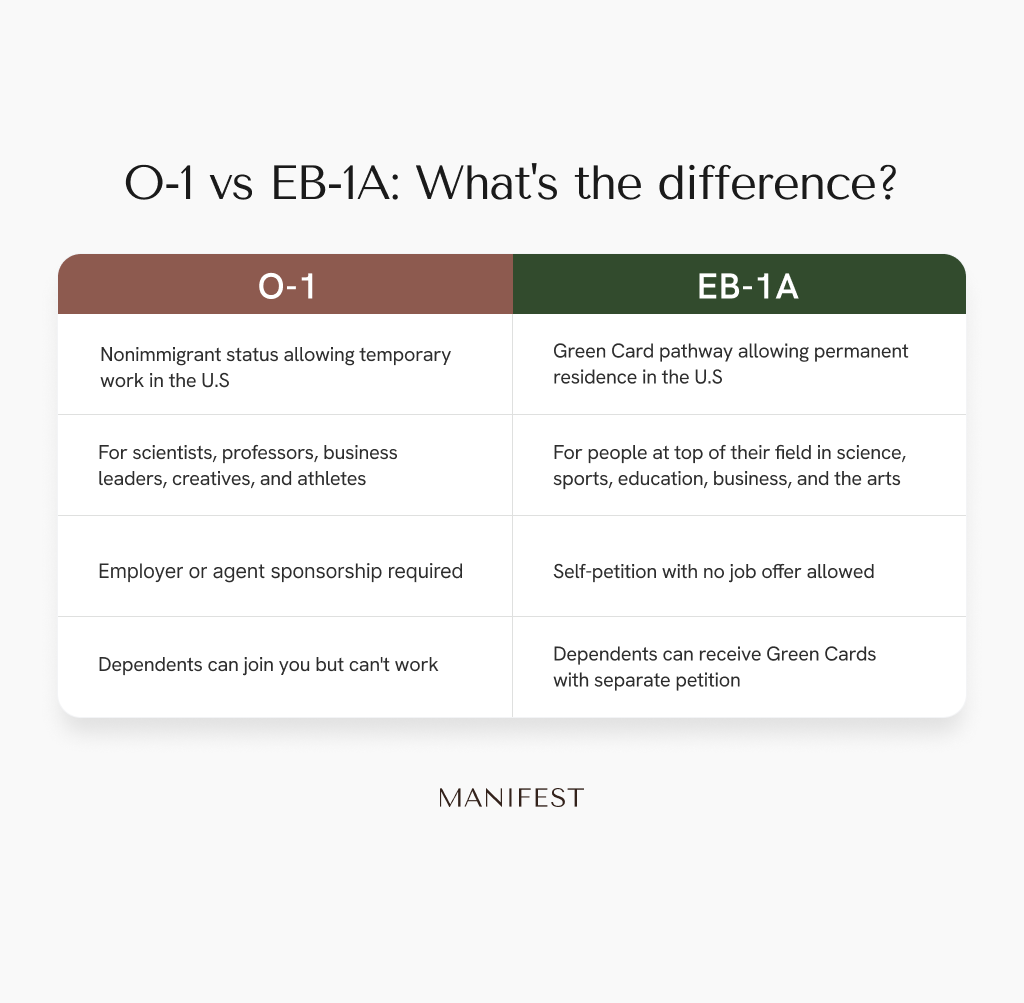
O-1 vs. EB-1A comparison chart
The columns below compare the two categories on the dimensions applicants weigh most. "Type" sets the legal status; the remaining rows track the practical trade-offs that follow from it.
| Feature | O-1 | EB-1A |
|---|---|---|
| Type | Nonimmigrant visa | Green Card |
| Leads to a green card? | No | Yes |
| Employer/sponsor required? | Yes, an employer or O-1 agent | No, self-petition is allowed |
| Approval rate (Q1 FY 2026) | ~91.0% | ~47.5% |
| Evidentiary standard | Top of your field | Top of your field plus sustained national/international acclaim |
| Country backlog risk | None | India and China have backlogs |
| Premium processing | $2,965 | $2,965 (covers I-140 step only) |
| Dependents | O-3 visa; spouse/children can't work | Spouse and children get Green Cards; spouse can work |
| Typical use case | Enter the U.S. faster for specific work | Settle permanently in the U.S. |
Which is faster, the O-1 or the EB-1A?
Generally speaking, obtaining an O-1 visa takes less steps and time than an EB-1A Green Card. As of June 2026, USCIS takes 12.5 months to complete 80% of O-1 cases, and premium processing returns a decision in 15 business days.
The EB-1A’s processing time takes much longer because there are several steps in the process, and only the I-140 petition allows for premium processing. The adjustment of status or Green Cad consular processing spans several months on average, and cannot be sped up.
The EB-1A is also subject to per-country Green Card limits, which means applicants from high-demand countries like India and China must wait years before they can even file for permanent residence. The O-1, in contrast, has no priority date or backlog, which is why many people from those backlogged countries use it to live and work in the U.S. in the meantime.
Do you need a sponsor for the O-1 or the EB-1A?
The O-1 requires a sponsor, while the EB-1A does not. Even if you have a U.S. agent that allows you to pursue freelance work, you cannot file Form I-129 on your own to get an O-1 visa. And if your role changes or ends, you may need an amended or new petition.
The EB-1A allows you to file on your own, without the need of a job offer, employer sponsor, or even agent. That independence can be especially attractive to founders and entrepreneurs who don't want their immigration status locked to one employer.
How do the eligibility criteria differ between the O-1 and the EB-1A?
Both the O-1 and EB-1A are adjudicated based on USCIS’s extraordinary ability criteria, and let you qualify if you meet at least three of them. But these differ, and Manifest immigration attorney Urizar says this is the biggest mistake people make when choosing between the two.
Meeting the O-1 bar can signal that you may qualify for the EB-1A, but it does not guarantee an approval. The gap between them is recognition over time, and oftentimes this takes several more months of continued career growth.
How do family benefits compare for the O-1 and the EB-1A?
The EB-1A offers stronger family benefits. On the O-1, your spouse and unmarried children under 21 can join you on O-3 status. This allows them to live and study in the U.S., but they cannot work.
With the EB-1A, your spouse and unmarried children under 21 can obtain Green Cards as your dependents. They don't need to qualify for extraordinary ability themselves, and once approved, your spouse and children can live and pursue employment in the U.S. indefinitely.
Can you hold the O-1 and pursue the EB-1A at the same time?
Yes, and many people do, but it carries more risk than with a dual-intent visa like the H-1B. O-1 holders can pursue a Green Card under certain circumstances, but the timing of your EB-1A filing matters greatly.
This is a difference worth understanding when you choose a starting point, because it shapes how cleanly you can move from a temporary status toward permanent residence. It's also why some people weigh the O-1 against the H-1B as a green card launchpad.
Which is better for you, the O-1 or the EB-1A?
Neither category is better, as they serve different stages of the same journey. The O-1 is the right call if you want to start working in the U.S. soon, you have an employer or agent to sponsor you, or your record is still building toward top-tier recognition. The EB-1A, on the other hand, may be a better option if your priority is permanent residence, you'd rather self-petition, and your achievements already reflect sustained national or international acclaim.
A simple way to decide:
- Choose the O-1 if you need speed, have a sponsor lined up, or aren't yet at the EB-1A evidentiary level.
- Choose the EB-1A if you want permanence and family green cards, prefer no employer, and can document sustained acclaim.
- Consider both, in sequence, if you qualify for the O-1 now and expect to meet the EB-1A bar later.
If you’re unsure whether the O-1 visa or the EB-1A path makes sense for you, Manifest Law can help you evaluate your credentials and map out a strategy that aligns with your goals.
From researchers to executives, our immigration attorneys guided clients through successful O-1 to EB-1A transitions with clear strategy and flat-fee pricing.
Request a consultation with Manifest Law today, and we can assist you through the requirements and process of the O-1 and EB-1A.
FAQs about the O-1 vs EB-1
Does qualifying for the O-1 mean you qualify for the EB-1A?
Not automatically. The two share criteria, but the EB-1A demands a higher standard of proof, so meeting the O-1 bar usually means you're approaching the EB-1A. Most people strengthen their record (more press, awards, judging, original contributions) before the EB-1A becomes realistic.
Which has the higher approval rate, the O-1 or the EB-1A?
The O-1 has a higher approval rate than the EB-1A. In the first quarter of Fiscal Year 2026, approval rates for the O-1 remained above 90%, while the EB-1A averaged to 47.5%.
Which is faster, the O-1 or the EB-1A?
The O-1 is often faster than the EB-1A, as cases are usually decided in a few months and can be expedited with premium processing. The EB-1A takes longer and has years of backlog for applicants born in India or China.
Do you need a job offer for the O-1 or the EB-1A?
You need a U.S. employer or agent for the O-1, but not for the EB-1A. The EB-1A allows self-petitioning, so you can file without a job offer.
Which is cheaper, the O-1 or the EB-1A?
It depends on several factors, including whether you have a sponsor, self-petition, or pay for certain immigration benefits. For more details, check out our O-1 and EB-1A cost breakdowns.
Can your family work on the O-1 or the EB-1A?
Only on the EB-1A. O-3 dependents (spouses and children under 21) can live and study in the U.S., but they cannot work. EB-1A dependents receive green cards, and the spouse can work legally in the U.S.
About the Author

Contributing Writer
Nupur Gambhir is a contributing writer at Manifest Law, where she turns complex visa info into clear, no-fluff guidance for people starting a new chapter in the U.S. She’s all about making the immigration process less overwhelming and more human.
Read bioReviewed By

Senior Immigration Attorney at Manifest Law
Henry is an Estonian American attorney licensed in Arizona with broad experience in employment-based immigration. He handles EB-1A, EB-2 NIW, O-1, and E-2 cases for founders, professionals, and creatives across industries worldwide, and has helped hundreds of clients achieve successful outcomes.
Read bioShare this article: