Key Takeaways
- Permanent residency allows long-term living and working in the U.S., but does not include all the rights of citizenship.
- U.S. citizenship provides full political rights, a U.S. passport, and greater security—but requires meeting naturalization criteria.
- Most applicants must hold a Green Card for at least five years before becoming eligible for citizenship.
In immigration law, “permanent resident” and “U.S. citizen” mean very different things. The status you fall under will impact so much of your experience in the United States, including your ability to vote, travel, access benefits, and your eligibility to stay in the U.S. long-term.
Understanding the difference between lawful permanent resident status and U.S. citizenship, and the implications of those differences, is a must for anyone considering building a life in the United States.
What is a lawful permanent resident?
A lawful permanent resident (also known as an LPR or Green Card holder) is a foreign national authorized by U.S. Citizenship and Immigration Services (USCIS) to live and work in the United States on a permanent basis.
This YouTube video is hidden until you accept functional cookies.
Permanent residents are issued a Green Card (also known as a Permanent Resident Card) under one of many Green Card eligibility categories—including family-based and employment-based Green Cards—as proof of their status.
Did you know? There are many different types of employment-based Green Card pathways. Read more about EB categories like EB-1A (extraordinary ability), EB-2 NIW (national interest waiver), and EB-3 (skilled workers) to discover which might fit your background and qualifications.
What is a U.S. citizen?
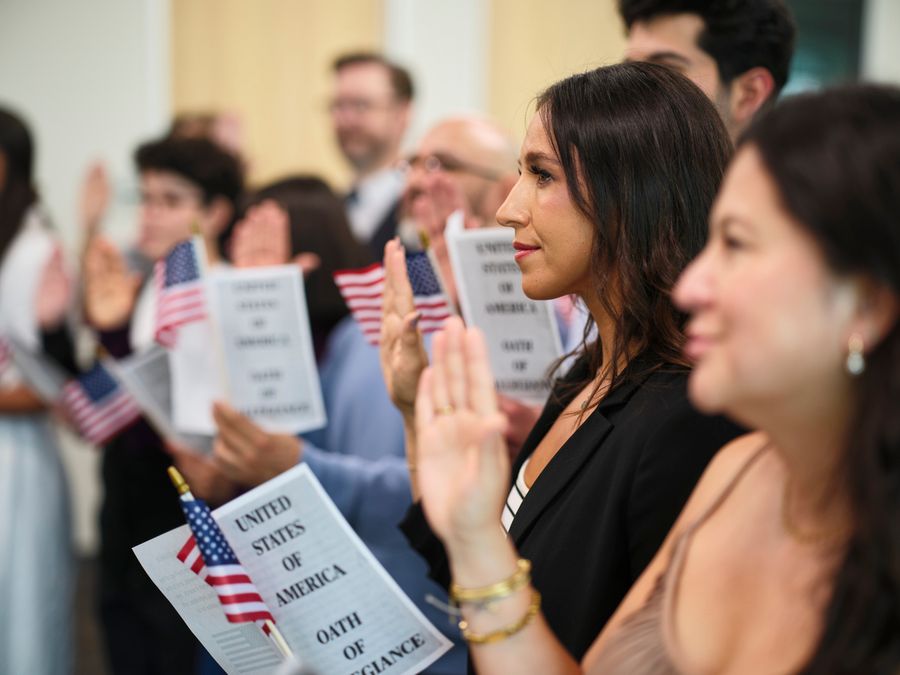
A U.S. citizen has more legal rights, privileges, and protections than a permanent resident, including the right to vote and run for office. Citizens can also hold a U.S. passport.
Citizenship can be obtained in one of three ways:
- Birth in the U.S. (known as birthright citizenship)
- Through automatic acquisition from U.S. citizen parents (if certain eligibility requirements, like custody and residency requirements, are met)
- Through naturalization, the process that allows permanent residents to apply for and obtain U.S. citizenship
Permanent residents vs. U.S. citizens: what you need to know
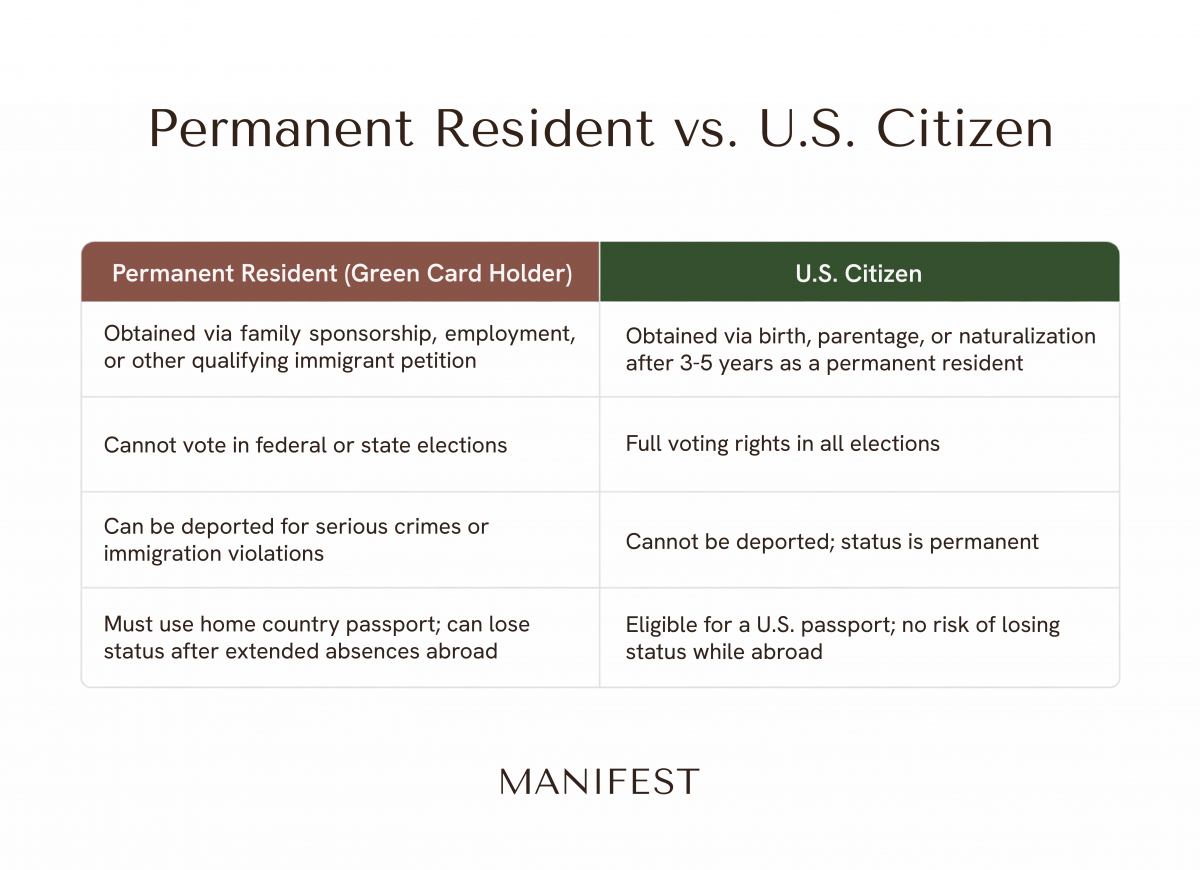
While there are definite similarities between permanent resident status and citizenship, there are also several important key differences:
| Category | Permanent resident (Green Card holder) | U.S. Citizen |
|---|---|---|
| Voting rights | Cannot vote in state or federal elections | Can vote in all state and federal U.S. elections |
| Deportation risk | Can be deported for serious crimes and/or immigration violations | Cannot be deported (except in rare naturalization fraud cases) |
| U.S. passport | Not eligible | Eligible |
| Travel | Generally required to spend at least 50% of each year physically in the U.S. Long-term international travel may be treated as “abandonment” of U.S. residency, and may disrupt the continuous residency required for naturalization eligibility. Trips longer than a year require a re-entry permit (via Form I-131) | Can live abroad long-term and even become citizens or permanent residents of other countries without losing their U.S. citizenship. No travel limitations |
| Federal government jobs | Not eligible for most federal government jobs (with limited exceptions) | Eligible to work for the federal government |
| Family sponsorship | Can sponsor spouse and unmarried children | Can sponsor spouse, children (married or unmarried), parents, and siblings |
| Public office | Cannot run for public office | Can run for public office |
| Jury duty | Not eligible | Eligible |
To summarize, both permanent residency and U.S. citizenship allow people to live and work in the U.S. long-term, but citizenship comes with significantly more rights.
What rights do U.S. permanent residents and citizens have in common?
Permanent residency and citizenship are two completely separate statuses. There is, however, a lot of overlap between the two—and permanent residents have many of the same rights as citizens.
Both U.S. citizens and permanent residents:
- Can live and work in the United States indefinitely
- Are protected under all federal, state, and local laws
- Must file and pay U.S. taxes on all worldwide income
- Can sponsor certain family members to immigrate to the U.S. (although citizens can sponsor more categories)
- Can serve in the U.S. military (although there are limited advancement opportunities for permanent residents/LPRs)
Starting the journey to permanent residency or U.S. citizenship
Permanent residency and U.S. citizenship both offer the opportunity to live and work in the United States indefinitely. By understanding the differences between the two, you can better evaluate where you are in your immigration journey—and which option offers the best, most logical step forward.
At Manifest Law, we understand the importance of permanent residency and U.S. citizenship, and we’re here to walk you through every step of the process. Whether you’re considering applying for a Green Card, are ready to go through the naturalization process, or just have questions, our experienced immigration attorneys are here to help.
Ready to take the next step towards building a long-term life in the United States? Request a consultation with Manifest Law today.
About the Author

Contributing Writer
Deanna DeBara is a freelance writer with a decade of experience covering a variety of topics, including immigration law. When she's not writing, she enjoys baking, dancing, hiking the PNW, and spending time with her rescue pups.
Read bioReviewed By

Princ. Immigration Attorney
Nicole is the founding legal architect and an immigration attorney with extensive experience across extraordinary ability, employment-based, and investment visas. As the founding legal architect, Nicole helped shape the engine of Manifest Law to serve our clients as effectively and strategically as possible.
Read bioShare this article: